

BROWSER tests
#/?kind=browser— drive a real page: click, fill, and assert what a person would see.
The same pane as an API test's, knowing a different set of words. A browser test opens a page and then does what a person would do to it. Each step is a row that opens in place when you pick it, exactly as a request does, and a locator field carries ⌖ pick: it opens the page, and the element you click is written into the field.
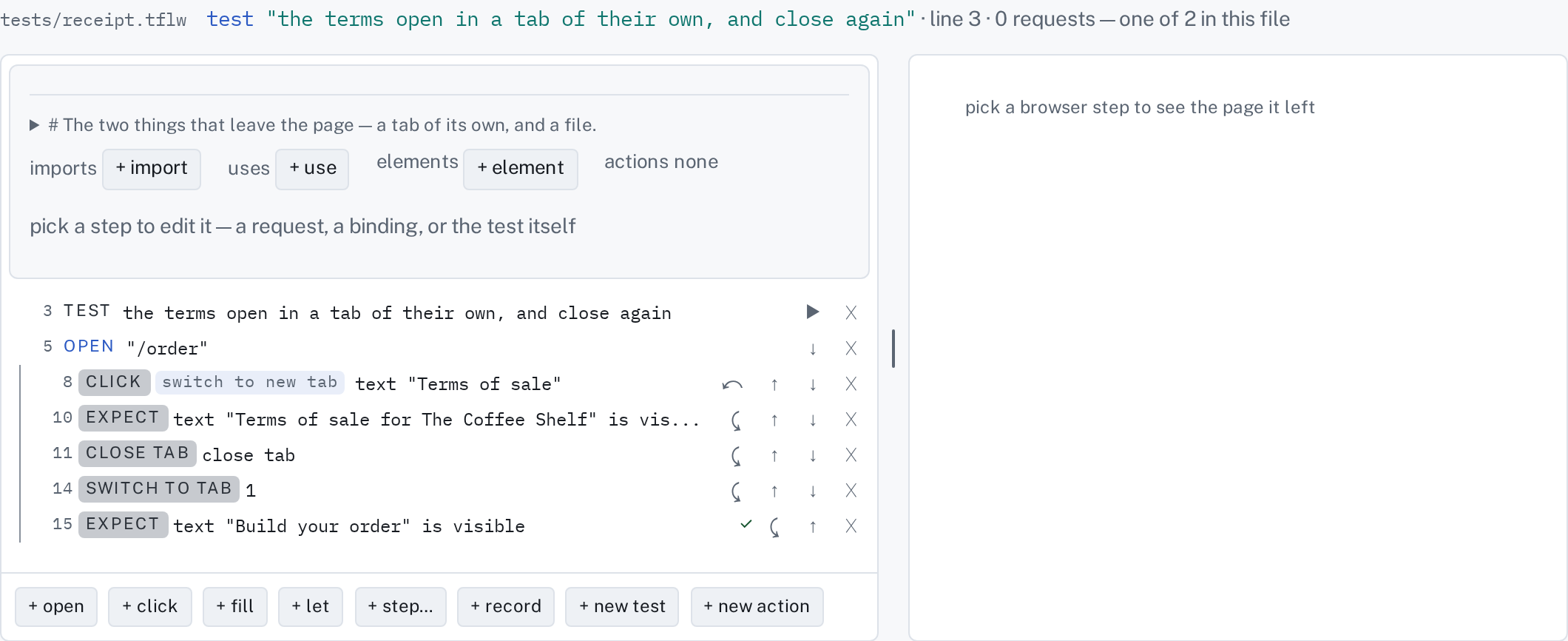
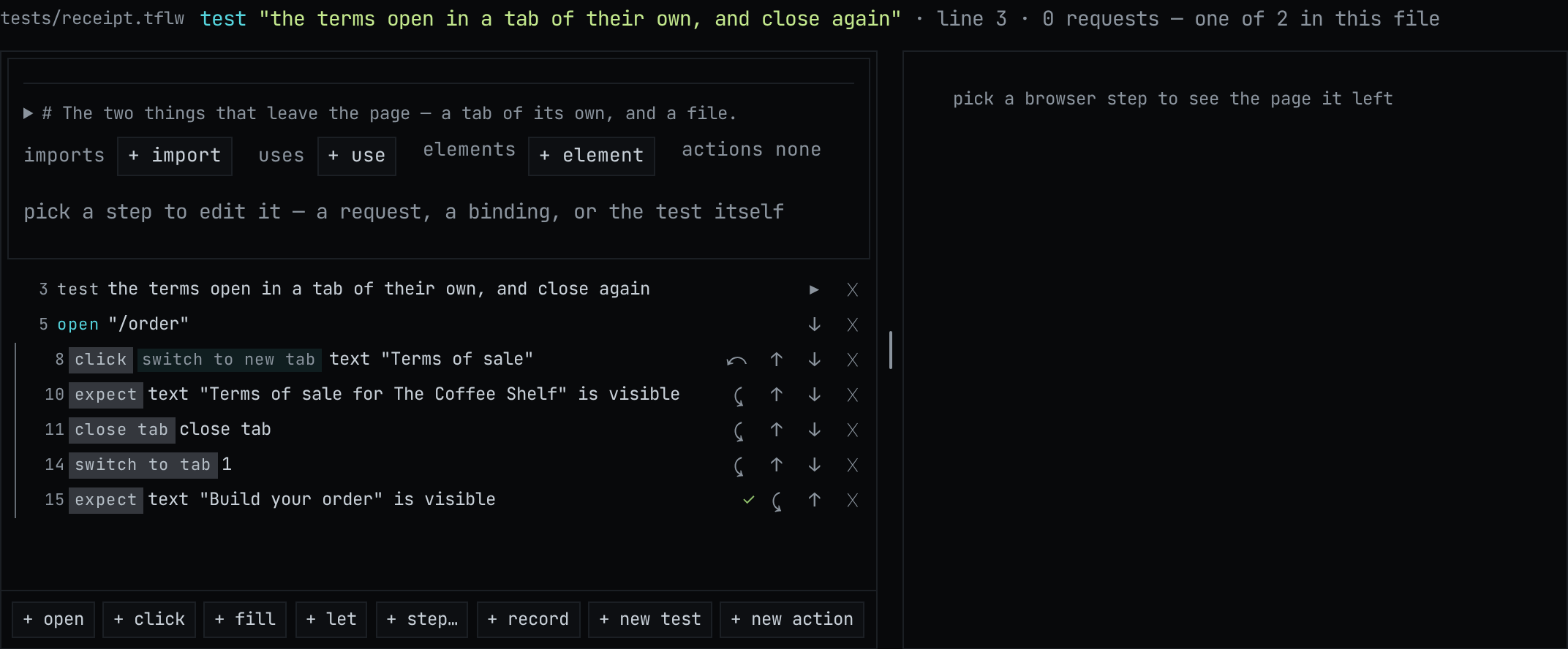
The right-hand column shows the page as the last run saw it at the picked step. A step records a
picture when it fails or when a screenshot statement takes one, so a clean step says it has none
rather than showing an empty frame.
What + new test writes here
Section titled “What + new test writes here”One line:
test "the shop page greets and the button answers" open "/"And deliberately nothing under it. The other three kinds scaffold an assertion because they can
derive one; this one cannot. The language has no url or title matcher to assert against, and what
text is actually on the page is the one thing the author has not seen yet. Measured on the two
corpora, 58.3% of visible opens are followed by a gesture rather than by an assertion — so
the honest scaffold stops where the author's knowledge starts.
What the pane offers
Section titled “What the pane offers”+ open, + click, + fill, + let, and then two that only a file with a page has:
+ step…— the rest of the language behind one press.click(874),fill(493) andopen(378) are 73% of the corpus's 2,395 browser statements; the other eighteen kinds are 217 occurrences between them, so they sit one press away rather than in a column of buttons that wraps to three rows.+ record— drive the page yourself and keep what you did as steps. Each gesture arrives as a row under the step you had picked, with keep and drop on it. ▶ try runs the test with the rows in it without keeping any. stop (or closing the browser) keeps what you kept and drops the rest. Nothing reaches the file until you write.
There is no Send here. A browser step is not a request you can re-issue for a look; ▶ beside the test runs it against a real page instead, and the run draws itself in the rows as it goes (see Running from the page).
Every browser construct is editable here
Section titled “Every browser construct is editable here”All twenty-two kinds the language has. That sentence is worth stating because until recently it was three: the other nineteen drew as plain, uneditable code lines with no disabled control and no reason given — 650 statements, 27% of all browser steps in the two corpora. Five of the nineteen already had working builders that nothing could reach.
Two surfaces reach them, and it is worth knowing which is which. + open, + click and + fill
sit in the pane's foot as gestures of their own. + step… holds the rest — a filterable list
of 24 entries: the eighteen browser kinds without their own button, plus call, capture,
give, log, pause and together, which are not browser words at all and which every kind
offers.
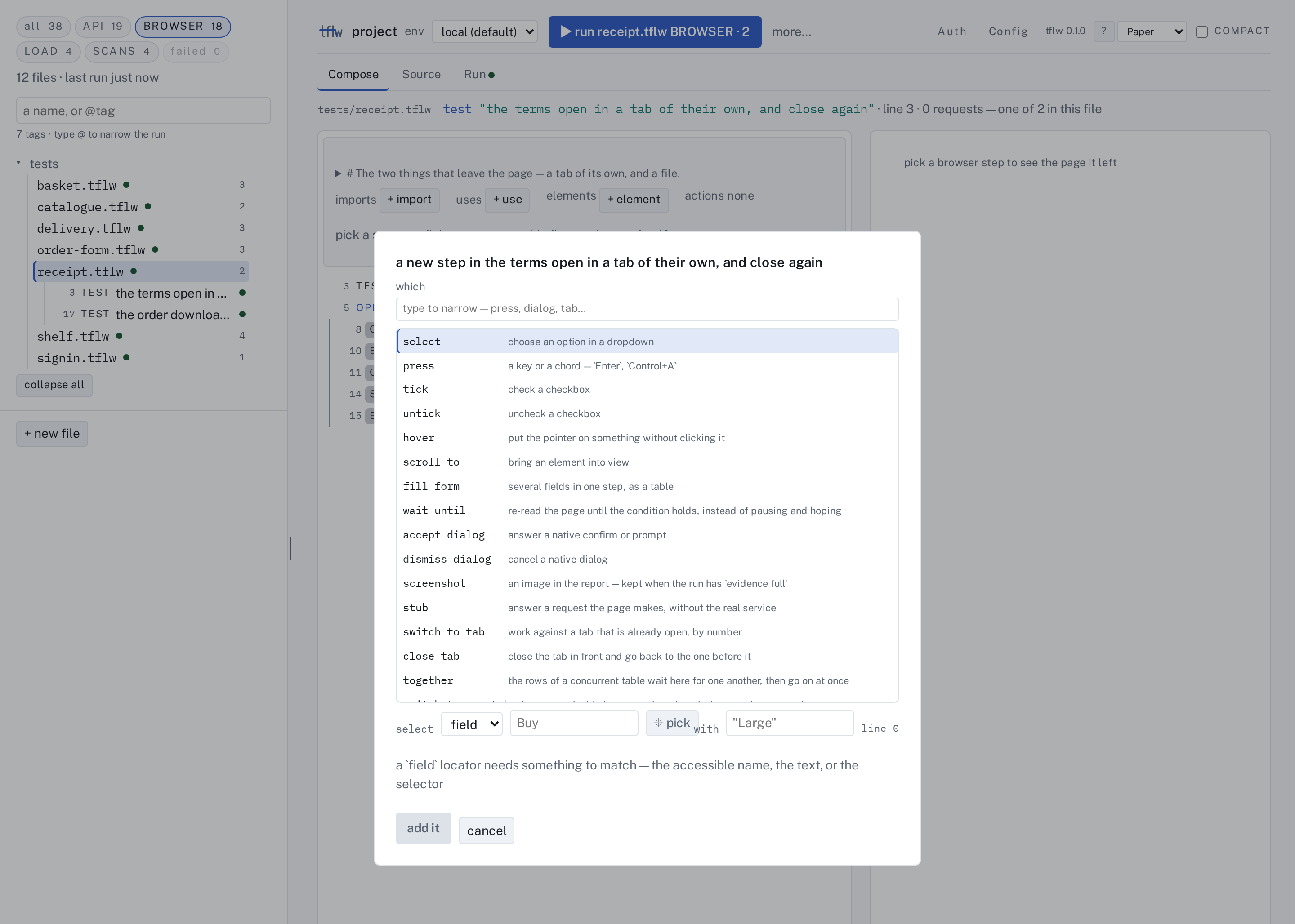
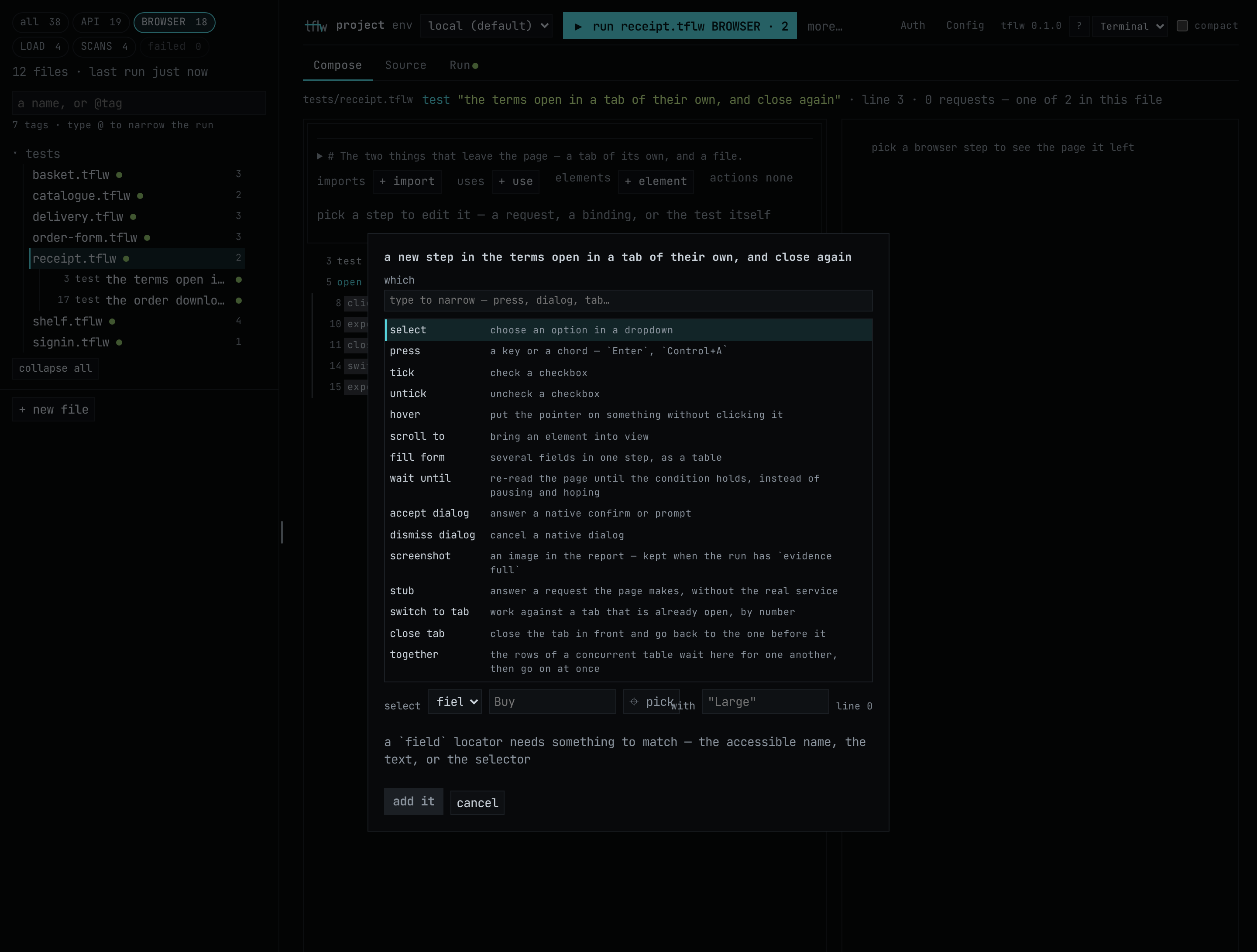
That is eighteen and three of the twenty-two. The twenty-second is within, which is a block with
a body rather than a step, and no + gesture writes one — you edit a within the language already
put there.