

The four kinds
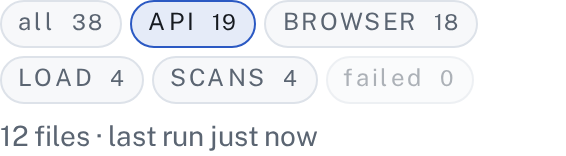
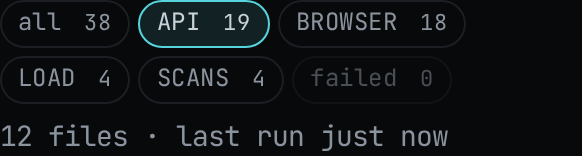
A kind is a kind of work — calling an API, driving a page, applying load, scanning — and a test is of every kind whose statements it carries. On the page the kinds are chips at the head of the file list, and a chip does two things and nothing else: it filters what the list shows and what ▶ runs, and it is where + new test starts when it asks what to scaffold.
| kind | the work | what + new test scaffolds |
|---|---|---|
| API | call an endpoint, assert what comes back, chain one call into the next | a request and the assertion that reads it |
| BROWSER | drive a real page: click, fill, and assert what a person would see | an open, and deliberately nothing under it |
| LOAD | run the work you already wrote at a rate, and hold it to a threshold | the API pair, plus a shape and a threshold |
| SCANS | crawl a surface and judge every response against a severity bar | the API pair, plus a severity floor |
Each kind has its own page above, with what Compose looks like on a real test of that kind.
A test is not filed under one
Section titled “A test is not filed under one”The kinds a test is of are derived from the statements it actually uses, so a test is counted under every chip whose work it does. Measured across this project's own corpus and its sibling, 231 of 761 tests — 30.4% — are of more than one kind. That is the whole reason the kinds are not four folders: a login that seeds state over the API and then drives a browser is one test doing two kinds of work, and filing it under either one would be wrong.
The count on a chip is therefore not a partition. The four counts can sum to more than all, and
usually do — in the picture above they sum to 45 across a project of 38 tests and crawls, which
is the overlap made visible rather than asserted. The other end of the same rule: a test whose every
statement is one no kind is about — a call, a binding, an assertion — is under no chip, and all
still counts it.
The same chip narrows a run from a terminal: tflw run --kind api runs the tests the API chip
shows, by the same derivation.
A chip filters; it grants nothing
Section titled “A chip filters; it grants nothing”This is the one rule worth carrying out of this section, because nothing on the page announces it: the chip you have on changes what the list shows and what ▶ runs, and nothing about the file you are looking at.
What Compose can do with a file is read off the file: a file with a page in it can be recorded, a file with a request can be sent, a file with a workload line shows the plan panel, a file
declaring an authorized target shows the targets block — under every chip, all included. Switch
chips with a file open and the pane does not change; switch files and it does.
Compose
Section titled “Compose”Compose is the authoring surface: the test's steps in file order, and the one you pick edited in place. The Source tab beside it shows the bytes the write will produce, so nothing is written blind.
It is one pane, not four. Every file draws the same surface at the same size; what differs is which words the file's own kinds know and which panels it has earned. The four pages above show it on a test of each kind.
Two things about it are worth knowing before you use it.
Send runs a prefix, not a request alone. Most requests in a real test read a value an earlier step bound — a token, an id, a created resource. Sending one in isolation would fail for reasons that have nothing to do with it, so there are two buttons and both send a run of requests in order: send this issues the selected request and the ones above it that feed it, and send all issues every request in the test. Each says how many it will fire before you press it.
Neither grades anything. Send shows you what came back; the assertions are checked when the test
runs — from ▶, with the verdicts landing on the same rows. Send also writes a scratch file beside your project, which the page tells
you about if your .gitignore does not already list it.
A picked row edits where it stands. A request, a statement, the test or the file: picking it
turns that row into its own editor, and the column beside the steps shows what came back for it.
The steps are in file order, statements included, because the interleaving is the point: a let
between two requests is usually what makes the second one work.
What + new test scaffolds
Section titled “What + new test scaffolds”+ new test and + new file ask which kind to start with — four chips in the dialog, starting
on the chip you have on — and write the third column of the table above; each kind's own page says
exactly what and why. It is a starting point and not a template: it is ordinary .tflw you then
edit, and the Source tab shows you exactly what it wrote.
The language is the same for every kind. A kind changes what you are handed, never what is legal.
A directory with no project yet asks the same question before anything else, and the answer is
tflw init's own flag: --load for LOAD, --scan for SCANS, nothing for the other two.